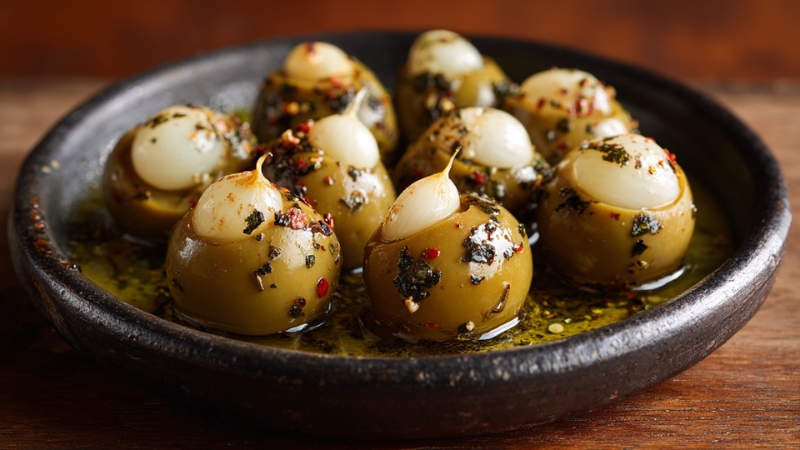
Yes, garlic-stuffed olives can offer real health benefits, but they are modest, context-dependent, and easy to overstate.
Nutrition experts generally agree that the combination delivers beneficial fats, plant compounds, and micronutrients, while also carrying clear trade-offs such as sodium and calorie density.
They are best understood as a flavorful, nutrient-contributing food rather than a functional or therapeutic one.
What Exactly Are Garlic-Stuffed Olives?
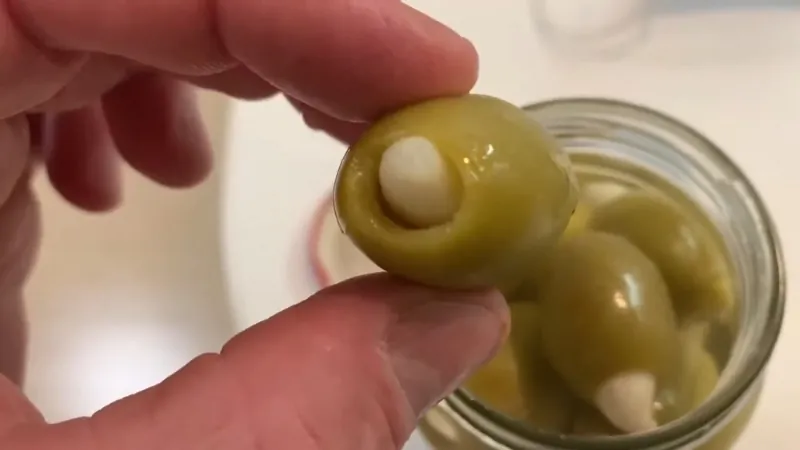
Garlic-stuffed olives are typically green olives cured in brine and filled with a clove or paste of garlic. Most commercial varieties use large green olives such as Manzanilla or Halkidiki because their firm flesh holds stuffing well.
The curing process removes natural bitterness from olives through salt brining or lye treatment, followed by fermentation or rinsing, then stuffing and packaging in brine or oil.
This processing matters nutritionally because it alters sodium content, polyphenol levels, and texture while preserving fat-soluble compounds.
From a dietary standpoint, the food is a combination of three elements: olive flesh, garlic, and brine. Each contributes differently to nutrition and health effects, which is why experts tend to evaluate the components separately before considering the whole.
Nutritional Profile at A Glance
Garlic-stuffed olives are not nutrient-dense in the way vegetables or legumes are, but they are not empty calories either. They primarily contribute monounsaturated fat, sodium, and small amounts of plant bioactives.
Nutrient (approx. per 5 medium olives)
Amount
Primary Source
Calories
45–55 kcal
Olives
Total fat
4.5–5.5 g
Olives
Monounsaturated fat
3–4 g
Olives
Sodium
300–450 mg
Brine
Fiber
1–1.5 g
Olives
Vitamin E
0.8–1.2 mg
Olives
Iron
0.3–0.5 mg
Olives
Allicin-related sulfur compounds
Trace
Garlic
Values vary widely by brand, curing method, and stuffing size, but this table reflects common commercial products found in European and North American markets.
The Olive Side – Fats and Polyphenols
View this post on Instagram
Nutrition experts consistently point to olives as a source of monounsaturated fatty acids, primarily oleic acid. Oleic acid has been associated with improved lipid profiles when it replaces saturated fat in the diet.
This association comes largely from Mediterranean diet research, including long-term observational studies and randomized dietary trials such as PREDIMED, which linked olive-rich eating patterns to lower cardiovascular risk.
Olives also contain polyphenols like hydroxytyrosol and oleuropein derivatives. These compounds have antioxidant and anti-inflammatory properties in laboratory and human studies.
However, curing significantly reduces polyphenol content compared with fresh olives or extra virgin olive oil. That means garlic-stuffed olives still contribute these compounds, but at lower levels than many people assume.
Experts often emphasize portion realism here. The polyphenol dose in a small serving of olives is meaningful but not comparable to that found in high-quality olive oil or whole fruits and vegetables.
The Garlic Contribution – Small but Biologically Relevant
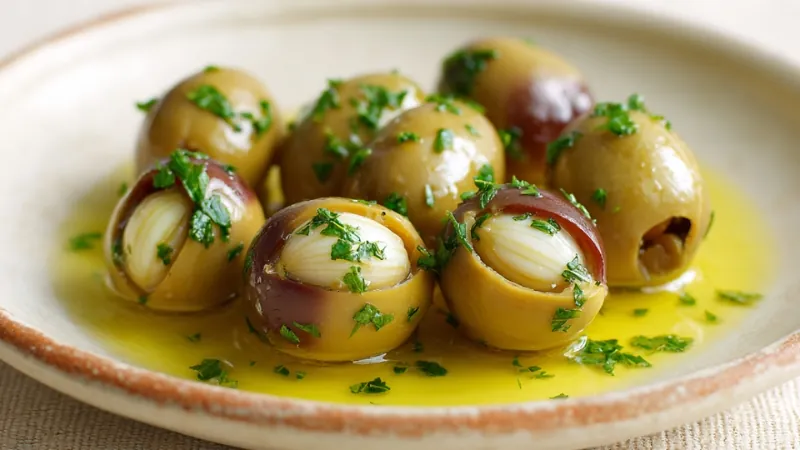
Garlic’s health reputation is largely tied to sulfur-containing compounds such as allicin, which forms when garlic is crushed or chopped. Allicin and its derivatives have been studied for potential effects on blood pressure, cholesterol, immune response, and antimicrobial activity.
In garlic-stuffed olives, the amount of garlic is relatively small, often less than half a clove per serving.
Processing and storage also reduce allicin formation and stability. As a result, the physiological impact is likely subtle. Nutrition experts describe it as a “supporting contribution” rather than a therapeutic dose.
That said, even small amounts of garlic add flavor without added sugar or refined carbohydrates, which is one reason dietitians often view garlic-stuffed olives favorably compared with ultra-processed snacks.
Sodium – The Main Nutritional Drawback
The biggest concern nutrition professionals raise is sodium. Olives are cured in salt, and garlic-stuffed varieties are no exception.
A modest serving can easily provide 15 to 25 percent of the recommended daily sodium limit, depending on national guidelines.
Product Type
Sodium per 5 olives
% of 2,300 mg limit
Regular brined garlic olives
350–450 mg
15–20%
Reduced-sodium olives
200–250 mg
9–11%
Rinsed before eating
250–300 mg
11–13%
For individuals with hypertension, kidney disease, or salt sensitivity, this is not trivial. Experts often recommend rinsing olives briefly under water to reduce surface sodium, which can lower intake by roughly 10 to 20 percent without major flavor loss.
Gut Health and Fermentation Considerations
Some olives are fermented rather than chemically cured, which can preserve certain bioactive compounds and introduce small amounts of beneficial bacteria byproducts.
However, most commercially stuffed olives are pasteurized, which means they no longer contain live probiotics.
From a gut health perspective, the benefit comes more from fiber and polyphenols than from probiotic content. Garlic contains prebiotic fructans, but again, the quantity in stuffed olives is small.
Experts would not classify garlic-stuffed olives as a probiotic or prebiotic food in a clinical sense.
Cardiovascular Context – Where They Fit and Where They Do Not
Nutrition experts generally agree that garlic-stuffed olives can fit into heart-healthy eating patterns when consumed in moderation. The fats align well with Mediterranean-style diets, and replacing processed snacks with olives may reduce intake of refined carbohydrates and trans fats.
However, they do not lower cholesterol or blood pressure on their own in any clinically meaningful way. Claims that they “clean arteries” or “boost immunity” are not supported by human evidence. Their benefit is contextual, not medicinal.
Weight Management and Satiety
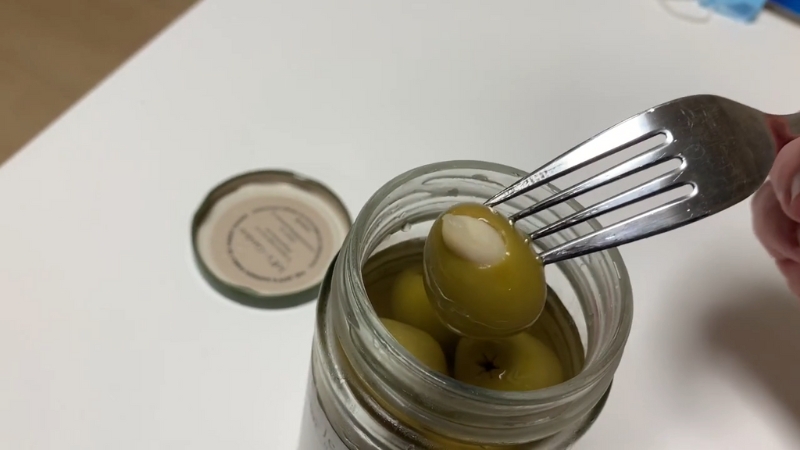
Olives are energy-dense relative to vegetables but less so than many snack foods. Their fat and fiber content can increase satiety, which may help with portion control when used intentionally.
Dietitians often note that a small bowl of olives can feel satisfying compared with chips or crackers.
The downside is that calories add up quickly if portions are unmonitored. Experts typically suggest thinking in terms of 5 to 7 olives rather than eating straight from the jar.
Comparison with Similar Foods
To put garlic-stuffed olives in perspective, nutrition experts often compare them to other savory additions.
Food (typical serving)
Calories
Fat Quality
Sodium
Notable Benefit
Garlic-stuffed olives (5)
~50
Mostly monounsaturated
High
Flavor, healthy fats
Plain green olives (5)
~45
Mostly monounsaturated
High
Slightly more polyphenols
Pickles (1 medium)
~5
None
Very high
Low calorie
Cheese cubes (30 g)
~110
Saturated + mono
Moderate
Protein, calcium
Nuts (15 g)
~90
Mostly unsaturated
Low
Fiber, minerals
This comparison shows why experts often view olives as a middle-ground option. They offer better fat quality than cheese, more flavor than nuts per calorie, but more sodium than most alternatives.
What Nutrition Experts Actually Say
Across dietetic associations and clinical nutrition literature, the consensus is cautious but positive.
Garlic-stuffed olives are described as a flavorful component of a balanced diet, not a health food in isolation. Experts emphasize ingredient quality, portion size, and overall dietary pattern.
When olives replace ultra-processed snacks or excessive animal fats, they can contribute to better dietary fat balance. When eaten mindlessly in large quantities, their sodium and calories can outweigh their benefits.
Bottom Line
@traziarae MY HANDS ARE CLEAN! But garlic stuffed olives YES! #garlic #fyp #foryoupage ♬ original sound – Trazia Rae
Garlic-stuffed olives do have health benefits, primarily from monounsaturated fats and plant compounds, with garlic adding a minor supportive role. These benefits are real but limited and highly dependent on portion size and overall diet quality.
Nutrition experts view them as a sensible, enjoyable addition to meals rather than a functional food or supplement. Used thoughtfully, they add flavor and nutritional value. Used excessively, they mostly add salt.

I’m Leo McIntyre, and my love for cooking was born in my grandmother’s kitchen, where I discovered the magic of traditional Southern recipes. Inspired by her passion and the flavors of my childhood, I started SouthernParm to share these treasured family dishes and keep the rich culinary traditions of the South alive for everyone to enjoy.